Entrain
The Neural Resonance Project

Entrain is a generative framework — a new musical language for creating precise spatial sound environments.

Each work is a singular installation whose real material is the listener's own perception.

It resists reproduction and cannot be scaled.

Entrain exists only in the moment, the room, the mind.

The brain runs on rhythm and resonance.

Beneath every moment of awareness, your brain is rhythmically coupled to the world around you, and to the life inside you — this is called neural entrainment.

These are the layered rhythms that shape your sense of time and self.

This music reaches them, by design.

Entrain is a musical practice grounded in an emerging theory of music cognition. Neural resonance theory holds that musical structure exists not in the sound itself but as physical, embodied dynamics in the listener's brain.

Our brains don't represent music abstractly—they become it.

This changes what music is, how we make it, and how we receive it.

For thousands of years, cultures have used rhythm, repetition, and immersive sound to reach altered states of consciousness. We build on that knowledge, informed by modern neuroscience, to create sensory environments that engage those capacities with new precision.

Entrain belongs to the lineage of composers — Reich, Riley, Pärt — who shaped consciousness through musical structure, now joined with a rigorous theory of how that structure lives in the brain.

The experience is simple: you enter a purpose-built acoustic room, sit back, close your eyes, and let the sound find you. No technique required — your role is to let the music find you. As you settle into the environment, the music begins to work with your own rhythms, and something shifts.

This work engages the act of perception itself — the material is, in some sense, the listener's own consciousness.

A New Kind of Music

With the Neural Resonance Collective — a collaboration of artists, scientists, and engineers — I'm fusing music composition, neuroscience, and consciousness research into a new category of perceptual and musical experience. When sound entrains the brain's own rhythmic architecture, the result is at once an aesthetic experience, a shift in awareness, and a process with measurable neural effects. I don't think these are separate outcomes, but same thing seen from different angles.

Music the listener completes. Not as audience, but as part of the composition.

These aren't songs or symphonies. They're not ambient wellness or focus playlists. Each musical environment surrounds the listener in three dimensions — sound arriving from above, below, and around them. It's like listening from inside the music. Being enveloped by sound, and by its subtle motion through space, engages the brain, the body, and the sense of self in ways that headphones or home speakers cannot replicate.

Entrain exists only as an in-person sound installation for individuals and small cohorts.

The brain is an intrinsically rhythmic organ. Across many frequency bands, its electrical activity oscillates continuously, and these rhythms shape perception, attention, and the sense of time passing. Heartbeat and breath are rhythmic too; the brain tracks them, and from that tracking comes the ongoing sense of being a body in the world.

When sound carries a strong temporal structure, these rhythms begin to synchronize with it — a phenomenon called neural entrainment. It is measurable, documented across decades of research, and familiar: it is what makes a foot tap to a beat. Entrain compositions are built to engage it well beyond the motor system — across the interlocking rhythms that govern perception, attention, and autonomic state.

This work is grounded in neural resonance theory: the account of how neural oscillations lock to external rhythm through nonlinear resonance, forming the stable patterns the brain experiences as musical structure, anticipation, and shifts in awareness.

The foundational science is well established and published in peer-reviewed journals. What remains an active area of research is how these mechanisms interact with consciousness, emotion, and individual difference. That boundary is held openly: the mechanism is real, the experience is real, and the full understanding is still unfolding.

You have the option to wear a lightweight EEG headband during your sitting, which records your brain's electrical activity in real time. It tracks entrainment as it happens and, over multiple sessions, reveals how your brain's response adapts and deepens.

Lineage

Entrain extends a long compositional lineage. From the intricate polyphony of medieval organum, through Arvo Pärt's tintinnabuli and Steve Reich's phase processes, composers have built music whose purpose is not entertainment but the shaping of a listener's perception and state of consciousness, often in sacred contexts. With La Monte Young's sustained drone environments and Pauline Oliveros's practice of deep listening, that purpose moved off the concert stage and into inhabited time and space — sonic environments to be entered and dwelt within, listening as a practice rather than an event. This is the form Entrain takes.

Older still are the ritual and ecstatic traditions that pursued the same end with rhythm and repetition — music meant to move the body before the mind, in ceremony and trance. These traditions understood through intuition what neuroscience now describes: that certain structures in sound produce specific shifts in consciousness. Entrain continues in this larger lineage, with tools and knowledge its predecessors never had.

Attunement

Each session engages the same process of neural entrainment. But with repeated experience, something further emerges — an attunement. The brain's oscillatory networks become more responsive to the temporal structures in the sound, so entrainment catches more readily, settles more deeply, and opens into territory that wasn't reachable at first.

This isn't the result of effort. It's the natural consequence of return — the nervous system growing more familiar with states it has encountered before. Subtle shifts in perception that were below the threshold of awareness early on become perceptible. The experience gains texture and nuance; what was fleeting becomes more readily available.

A single sitting is complete in itself. But those who return tend to find that the experience evolves — not because the sound changes, but because they do.

Matthew Bennett
Matthew Bennett
Composer · Director, The Neural Resonance Collective
One of the most-heard composers you've never heard of — now returning to the question beneath all of it: what sound does to consciousness.

I work with sound, time, and the listening body.

I'm a musician, ethnomusicologist, and practice-based researcher. At age four, I was obsessed with finding resonant intervals on my mother's piano. I began composing at age eight and that impulse — to shape time with sound — has guided everything since, through several different paths that have always asked the same question: what does sound do to consciousness?

After a Downbeat Competition prize in high school, I pursued music performance at the University of North Texas. I studied ethnomusicology at the University of Washington, where my graduate research focused on the anthropology of time, psychoacoustics, and cognitive psychology. After that, fieldwork in North Africa, studying how different cultures organize temporal and sensory experience through music and ritual.

As Director of Sound Design at Microsoft for more than a decade, I created the sounds heard on more than a billion devices every day. I founded the Sound & Sensory Design Program, led sound design for global technology platforms (Windows, Xbox, HoloLens, Outlook), and collaborated with Microsoft Research on spatial audio for immersive computing.

Now, through Entrain, I'm returning to my foundational questions with a theoretical framework and a production capability that didn't exist before. As a practice-based researcher, I'm also the author of the Multiscale Resonance Model, a working framework proposing that the human brain and consciousness share an inherently musical structure.

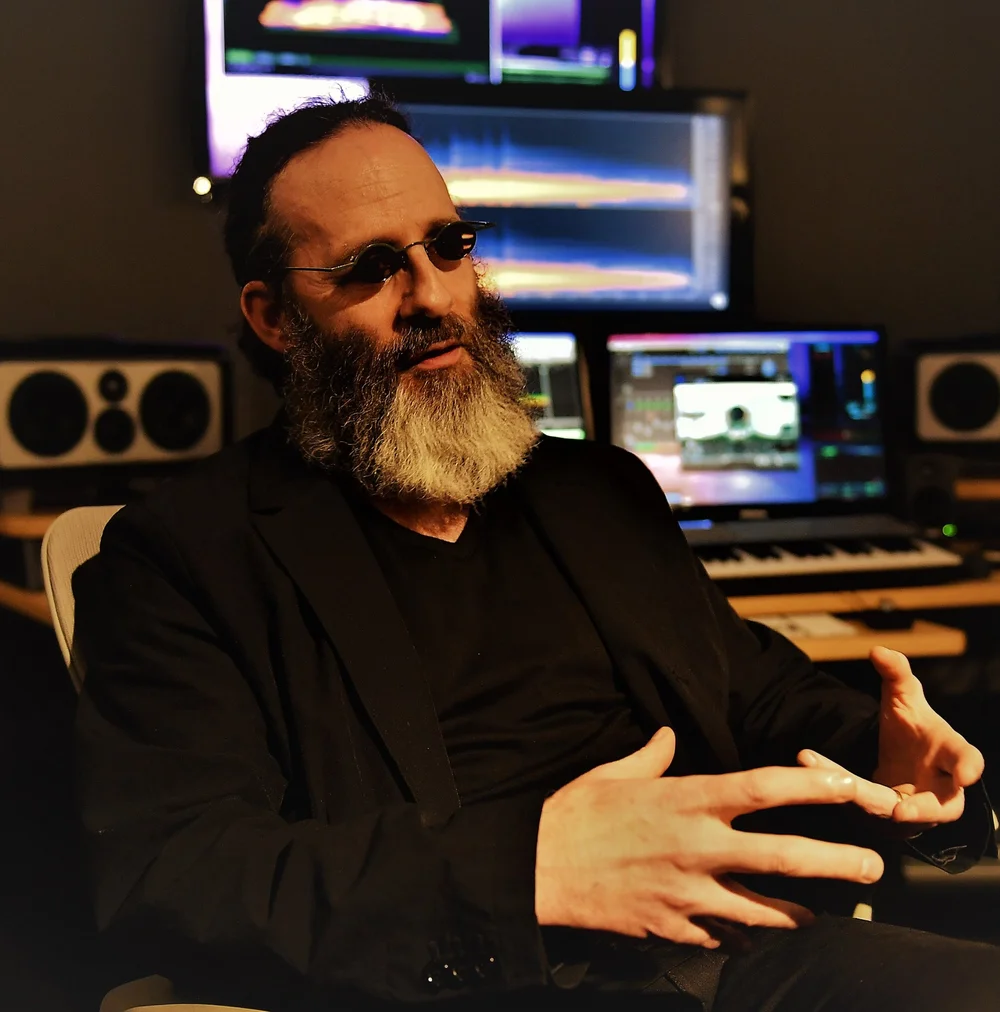
Matthew Bennett in the studio
The Neural Resonance Collective

Entrain is developed through the Neural Resonance Collective — a collaboration of artists, scientists, and engineers working at the intersection of music composition, sensory design, neuroscience, and consciousness research.

We believe that music is not simply entertainment that happens to affect the brain. It is a technology — the oldest one — for shaping the temporal dynamics of perception and consciousness. Our work is to bring a new kind of artistic language, and the precision of modern neuroscience, to that ancient capacity.

Entrain is an evolving practice, shared with individuals and in small cohorts, by invitation. If you'd like to be in occasional correspondence as it develops, you're welcome to write.

matthew@soundandsensory.com

Entrain works with the nervous system’s own capacity to synchronize with sound. We advise caution for anyone with active psychotic conditions, uncontrolled seizure disorders, or recent severe trauma without support.